Assessment Framework
The Monitor assessment framework is designed to measure inclusions and exclusions holistically across political, economic and social dimensions.
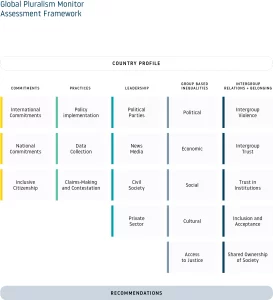
The Global Pluralism Monitor Assessment Framework reflects the Centre’s dual focus on institutions (hardware) and mindsets (software) and the complex interactions between the two. The Framework helps assessment teams tell the story they want to tell about a specific country, highlighting the best and worst examples of pluralism. This is done through a country profile, 20 indicators, and recommendations for policy and practice. The indicators span 5 dimensions: Commitments, Practices, Leadership, Group-based Inequalities, and Inter-Group Relations and Belonging. This section provides guidance on using the framework as well as detailed descriptions of its components.
The Global Pluralism Monitor assessment starts with a country profile wherein expert assessors provide relevant contextual factors and explain why specific forms of diversity are chosen for the assessment. Country profiles also allow teams to discuss important factors affecting pluralism in a country that cut across several or many indicators to avoid repetition of that information throughout the assessment.

Commitments
For pluralism, commitments are the most prominent way for states to declare their intent to build inclusive societies, and for non-state actors to keep states accountable. Commitments to pluralism can anchor other efforts to make society’s hardware and software more inclusive.

II. Practices
While commitments are important, pluralism requires sufficient political will and action to realize commitments in practice. This dimension includes three measures for assessing the extent to which practices of the state reflect a desire to build more inclusive and equal societies:

III. Leadership for Pluralism
Leadership for pluralism can look different from sector to sector, but is always rooted in a fundamental recognition that all groups deserve dignity and should feel that they belong.

IV. Group-Based Inequalities
Building pluralistic societies requires addressing group-based inequalities at all levels.

V. Intergroup Relations and Belonging
In order for pluralism to flourish, there needs to be consensus between groups and individuals that everyone deserves dignity and belong in society.

Recommendations
Recommendations constitute the final element of the Monitor’s assessment framework. Assessment teams provide preliminary recommendations based on the findings.
As a conclusion to the report, assessors will provide preliminary recommendations for policymakers and practitioners based on the findings. These are meant to be starting points for broader discussions with relevant stakeholders to translate the analysis from the report into actionable items. In successive reports, assessors can also reflect on whether recommendations have been acted upon in meaningful ways.