Sri Lankan Elections
Reconciliation, economic stability and anti-corruption are all at stake in Sri Lanka's 2024 elections.
During the Centre staff’s first trip to Sri Lanka in November 2023, expectations and concerns about the potential of the upcoming elections were echoed by almost everyone we met. Worries about possible delays were widespread, especially after the delays of the local elections in March 2023 due to the financial crisis. However, with the presidential elections now scheduled for Saturday, September 21, 2024, Sri Lanka stands at a potential turning point for reconciliation and the fostering of pluralism.
The Context: Economic Crisis and Majoritarianism
Sri Lanka’s current political environment is heavily influenced by an ongoing economic crisis and massive anti-government protests, known as the Aragalaya, that took place in 2022. Voters are also grappling with long-standing issues like Sinhala majoritarianism, which has come to define the diversity framework of the multi-ethnic and multi-religious island, and the unresolved question of devolution (granting more power to the different provinces of Sri Lanka).
Key Parties and Candidates to Watch
Ranil Wickremesinghe, Independent, United National Party Leader
The incumbent, Wickremesinghe, is the current frontrunner for the election and has support from over 30 parties and from the majority of parliament. However, the corruption and austerity measures that characterized his government have made him unpopular among many Sri Lankan youth.
His campaign highlights the economic stability that his government has fostered in the past two years through a deal with the IMF. Wickremesinghe’s proposals for a second term include an economic system based on the concept of Theravada Buddhism, or ‘the way of the elders,’ a potential appeal to the country’s Sinhala Buddhist majority. While throughout his presidency Wickremesinghe has expressed a commitment towards reconciliation, no tangible progress has occurred.
Sajith Premadasa, Samagi Jana Balaweaga Party, leading opposition
Premadasa’s progressive yet populist party came second in the 2022 parliamentary elections. This time around, Premadasa’s platform focuses on re-negotiating the IMF deals and promoting economic policies that support lower-income Sri Lankans. The most significant proposal he has brought forward is a constitutional reform to fully implement the 13th Amendment, done in consultation with religious, civil society and political leaders. This reform would see power being devolved to provincial councils, providing land powers and authority over the police in the northern and eastern regions of Sri Lanka. His anti-corruption stance further strengthens his appeal.
Additionally, Premadasa has pledged to strengthen the Office of National Unity and Reconciliation, as well as the Office for Reparations.
Anura Kumara Dissanayake, Janatha Vimukthi Peramuna (JVP) party, National People’s Power coalition
While the JVP party only holds three parliamentary seats, many Sri Lankans are turning to Dissanayake as a political alternative to the current government. Moving away from JVP’s Marxist-Leninist stance, Dissanayake has endorsed the current IMF programme and a government under his leadership could see a continuation of this programme but with a reformed tax administration system. Additionally, he has advocated for a change in the political culture of Sri Lanka, promising to go after corrupt politicians.
Regarding reconciliation, Dissanayake has committed to expanding the work of the Truth and Reconciliation Commission and to establish a mechanism to explore what occurred during the civil war.
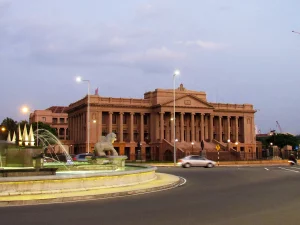
The old Parliament building and currently the Presidential Secretariat in Colombo, Sri Lanka, is in close proximity to where the Aragaleya took place in 2022.
What’s at Stake: Reconciliation and Power Sharing
The need for meaningful reconciliation emerged as a key theme in the Global Pluralism Monitor: Sri Lanka report and during Centre staff’s visit in 2023. The impact of the lack of reconciliation since the end of the civil war in 2009 was reflected across discussions on the challenges faced by Tamil and Muslim populations in Sinhala-majority areas and the visible tensions when discussing pathways for social harmony.
The lack of a plan for reconciliation from any of the leading candidates is highly concerning, as discussion on these issues is necessary to help rebuild trust between state and society across the country, particularly among those most impacted by the civil war.

The Mullivaikkal monument was first built in Jaffna, in 2019, to honor the Tamils who perished at the end of the armed conflict in 2009. After being destroyed in early 2021, it was rebuilt later that year.
Premadasa’s commitment to a constitutional reform that focuses on devolution holds the promise of giving more local power to Tamils in the north and east. Wickremesinghe’s campaign has also mentioned power-sharing with Tamils, and Dissanayake has spoken of establishing relevant truth and reconciliation mechanisms. However, as Dr. Neil DeVotta, who has supported pluralism strengthening in Sri Lanka with the Centre, points out, none of the current candidates present an alternative or an opportunity to challenge the majoritarian ethos of the country. Without centering the discussion of power-sharing or devolution in a context of reconciliation, or challenging the culture of impunity and providing reparations to those most impacted by the war, things are unlikely to change regardless of the success of economic or foreign policy.
Reconciliation must also address the grievances from the Muslim community, including justice for the cremations that took place during the COVID-19 pandemic, attacks against mosques, and other religious discrimination they have suffered.
Likewise, the key candidates have not sufficiently addressed a potential political solution that responds to the needs and aspirations of the Tamil communities in the northern and eastern regions.
The Tamil community itself faces internal debate over which candidate to support. The Ilankai Tamil Arasu Katchi (ITAK), a prominent political party representing the interests of Tamils in the northern and eastern regions, endorsed Premadasa. Tamils also voted for him in large numbers in 2019. On the other hand, a former ITAK member, P. Ariyanethiran, has presented himself as a “common Tamil candidate.” Nonetheless, ITAK has asked Ariyanethiran to withdraw from the presidential race to avoid dividing the Tamil population’s votes.
How the Tamil communities vote will significantly impact the election, as it will reflect their trust in a candidate’s ability to bring about political and socioeconomic equality.

An image from the Aragalaya protest movement in 2022, in front of the Presidential Secretariat. These protests called for better economic policies and anti-corruption measures.
AntanO
What this means for pluralism
For pluralism to flourish in any society, diversity must be valued and elevated as an asset. In Sri Lanka, the issues of reconciliation, moving away from being an ethnocracy and providing equal rights to Tamils and Muslims across the country are all key steps on the country’s pathway to pluralism. The economic crisis, and how the successful presidential candidate continues to respond to it, will also be key for pluralist outcomes in Sri Lanka.
Despite Wickremesinghe’s claims that the IMF reforms have brought about economic stability, the Institute of South Asian Studies in the National University of Singapore details how poverty and inequality have grown under his government. Socioeconomic equality, as well as cultural and political equality for all, are crucial for fostering a sense of belonging for all. Anti-corruption policies, an approach for power-sharing with Tamils, and economic policies that address the needs of all must go beyond rhetoric and be presented as tangible action plans that can help promote social harmony in Sri Lanka from all parts of society.
By Andrea Gonzalez