Australian Elections
Key issues worldwide like energy, affordability and immigration are reflected in Australian’s priorities at the polls.
Australians are heading to the polls on May 3rd. Polls are predicting a tight race between incumbent Prime Minister Anthony Albanese of the Labor Party, and opposition leader, Peter Dutton of the Liberal Party (who leads the long-standing Liberal-National Coalition). The Global Centre for Pluralism is closely following the elections of all countries assessed as part of our Global Pluralism Monitor. As Australians elect a new government, we are considering how this election might impact Australia’s drivers of pluralism identified in our Global Monitor: Australia report: diverse political representation, multiculturalism and support for Indigenous Peoples.
High cost of living impacting voters
Like other countries that have recently held elections such as Germany and Canada, Australia is facing high inflation and a housing crisis, which are voters’ top priorities in this election. This economic crisis is impacting Australians of all backgrounds and geographies. However, the Global Pluralism Monitor: Australia report notes that women, asylum seekers, and Aboriginal and Torres Strait Islanders face added structural inequalities. It would be important that the incoming government includes these groups when designing and implementing policies to improve affordability and access to housing.

A tent in Sydney that reads, "For many, this is what affordable Sydney housing looks like."
Red Flag Australia
So far, Labor and the Coalition are focused on making homes more affordable for first-time buyers (the Dutton Coalition also includes older women as a focus to support in purchasing a home), specific tax reforms, and lowering inflation. Labor released an official commitment to women late in the campaign which focuses on improving their economic outcomes and improving responses to and prevention of gender-based violence. The Labor Party has a Reconciliation Plan in effect from 2023-2025 but have not included specific mention of Indigenous peoples in their general platform. The Dutton Coalition’s platform includes specific promises for “practical action” to support Indigenous peoples’ wellbeing, including providing more housing. However, critics argue this is a distraction from meaningful reform and have raised concerns that policy decisions are being driven by political ideology rather than engagement with First Nations peoples.
Indigenous self-determination in a post-referendum landscape
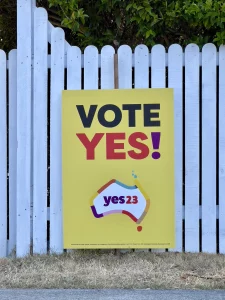
In 2023, the Labor government initiated a referendum asking Australians to approve a change to the constitution that would recognize and create a body for Aboriginal and Torres Strait Islander peoples to be represented in parliament on matters relevant to them. The Albanese government supported a “yes” vote. The referendum failed, not least because of the “no” campaign run by Dutton’s Coalition, who argued the referendum contributed to dividing Australians and focused on the needs of a “minority group” instead of the needs of a majority group during an inflation crisis.
This is a trend we are seeing worldwide: a zero-sum mindset that uses economic crises as the reasoning to push group rights aside. This approach is incompatible with pluralism and fosters a belief that resources for one group mean fewer resources for the others, contributing to distrust and sometimes violence between groups.
Since the referendum, issues related to Indigenous Australians and governance have been missing from the national conversation. Neither the Labor Party nor the Coalition have indicated whether they would adopt the UN Declaration on the Rights of Indigenous Peoples if elected, despite calls to do so by organizations like Indigenous Allied Health Australia, who argue it would enshrine basic rights for Indigenous peoples.
Australians call for stronger response to the war on Gaza
The current government’s response to the war in Gaza may have an impact on Australians’ voting decisions. Many Australian Muslims and youth, especially those with Palestinian origins, have expressed discontent or frustration about the government’s response to the war in Gaza. While both major parties support a ceasefire, some Australians are calling for their government to publicly state that Israel is committing genocide and to recognize Palestinian statehood. Politicians from major parties, who are competing against independent candidates running in Muslim-majority areas, were less present for Eid al-Fitr celebrations than in previous election cycles. One reason is that many in these communities disagree with the government’s response to the war in Gaza. Another reason is while some see political appearances at these events as a positive indicator of the success of multiculturalism, others see it as performative and inappropriate in places of worship and are frustrated that they do not often see politicians visiting these places of worship between elections.
Many Jewish Australians are concerned about rising incidents of antisemitism resulting in violent attacks nationwide. Australian Federal Policing initiated Special Operation Avalite to investigate increasing threats, violence and hatred towards the Australian Jewish community, including parliamentarians. There are questions about whether some of these attacks may have been organized by foreign actors. In early 2025, the Labor government almost unanimously passed anti-hate crime laws, including jail time for those who give Nazi salutes. This represented a moment of unity between the often at-odds Labor and Coalition parties, though Dutton still claims that Labor has not done enough to protect the Jewish community. Critics argue Dutton is politicizing the issue to gain votes.

Refugee Council of Australia
Restrictive immigration laws
Although Prime Minister Albanese is running as the more progressive candidate, he worked closely with the Coalition late last year to pass three restrictive immigration bills. These bills enable Australia to pay third countries to receive non-citizens as opposed to welcoming them to Australia (regardless of whether the other country has signed onto the UN refugee convention); impose criminal penalties for non-citizens who refuse to cooperate with their own deportation; and create new powers to search for drugs and confiscate phones in detention. These laws have been widely criticized by bodies like the Australian Human Rights Commission and the United Nations High Commission for Refugees. Prime Minister Albanese promised to reduce migration significantly, although his government has not yet delivered on that promise, and Mr. Dutton also promises to do so.
Like in Canada, many Australians link high immigration levels to housing shortages, even though housing shortages and rising costs far outpace the number of newcomers welcomed to the country. Rachel Stevens from the Australian Catholic University suggests that Australia can look to previous times of high levels of migration and economic uncertainty, like the gold rush of the 1850s and the post-WWII era, for lessons in how to support both immigration and housing affordability. Stevens argues that a focus on unity and nation building as opposed to promoting social division for political gain resulted in adaptation and innovation to create new forms of housing which benefitted Australians, including newcomers. This pluralistic approach demonstrates the link between social cohesion and economic outcomes: if we embrace differences instead of letting them divide us, we can better tackle society’s challenges together.
Staying on a pluralistic path in Australia
Voting is mandatory in Australia, which makes governments more representative of the population and parties more moderate overall, and can result in better inclusion of marginalized groups, which parties must get onside if they want to win seats. We are not seeing the extreme, far-right rhetoric mainstreamed in Australia as has been the case in other countries, though Dutton has been accused of racism in public commentary. A group of Palestinian-Australians, Arab-Australians and Muslim- Australians, led by the president of the Australian Palestine Advocacy Network and a Jewish professor, filed a complaint with the Australian Human Rights Commission which alleges that Dutton’s public comments in October 2023 made them feel “dehumanised … and humiliated as an ‘Other’ who does not and should not matter to Australia.” While Prime Minister Albanese is an advocate for climate action, LGBTQ+ inclusion and working-class Australians, he has advanced highly restrictive immigration policies condemned by human rights organizations which allege they violate principles of the UN Refugee Convention.

Young voters in Australia
Ellie Mueller, Australian Institute of International Affairs 2023
As is the case in other Monitor countries, more moderate politics can sometimes create blind spots to social division or the lived realities of diverse Australians. They can also result in complacency – neither party is making promises that will significantly alter the course of climate change, adopt UNDRIP, or address gender inequalities described in the Global Pluralism Monitor: Australia report – which may not move them ahead on their pluralism journey. A 2024 study from the Scanlon Foundation on Mapping Social Cohesion found that Australians remain strongly socially connected and accepting of difference. For example, 85% of Australians agreed that multiculturalism has been good for Australia and 8 in 10 have two or more close friends from different national, ethnic or religious backgrounds. However, young Australians in particular are concerned about social cohesion in Australia, and rightfully so. The same Scanlon study found that 49% of those surveyed agreed that Australia was welcoming too many immigrants (more than twice the number from 2023) and expressed concerns around migrants taking jobs or raising housing prices. In the midst of an affordability crisis for most Australians, this suggests that personal wellbeing and economic concerns can sow divisions and cause us to feel like we are in competition with our neighbours for resources. Instead, we can choose to work together across our differences to find solutions that strengthen our communities and economies for everyone.
Youth are bearing the brunt of a changing global order, economic challenges and climate change. They also represent the future of Australia.
This is the first election that youth (Gen Z and millennials) outnumber any other generation of voters and have the power to shape the election results. Youth are dissatisfied with the two main parties and fear that they are moving to the right, while young women and, at a slower rate, young men, are moving politically to the left. Young people do not share loyalty to or confidence in the two major parties compared to older Australians and are looking to independent candidates who they think can help them move into the future more safely and securely. Youth are bearing the brunt of a changing global order, economic challenges and climate change. They also represent the future of Australia. Parties have a responsibility to respond to youth’s push for more pluralistic policies not just for their own short-term political success, but to reshape the future of Australian democracy that responds to the needs of voters in the long-term. We know that Australians will need to work together across all forms of difference – including age – to tackle the growing global challenges we all face.
By Carolyn McKee.